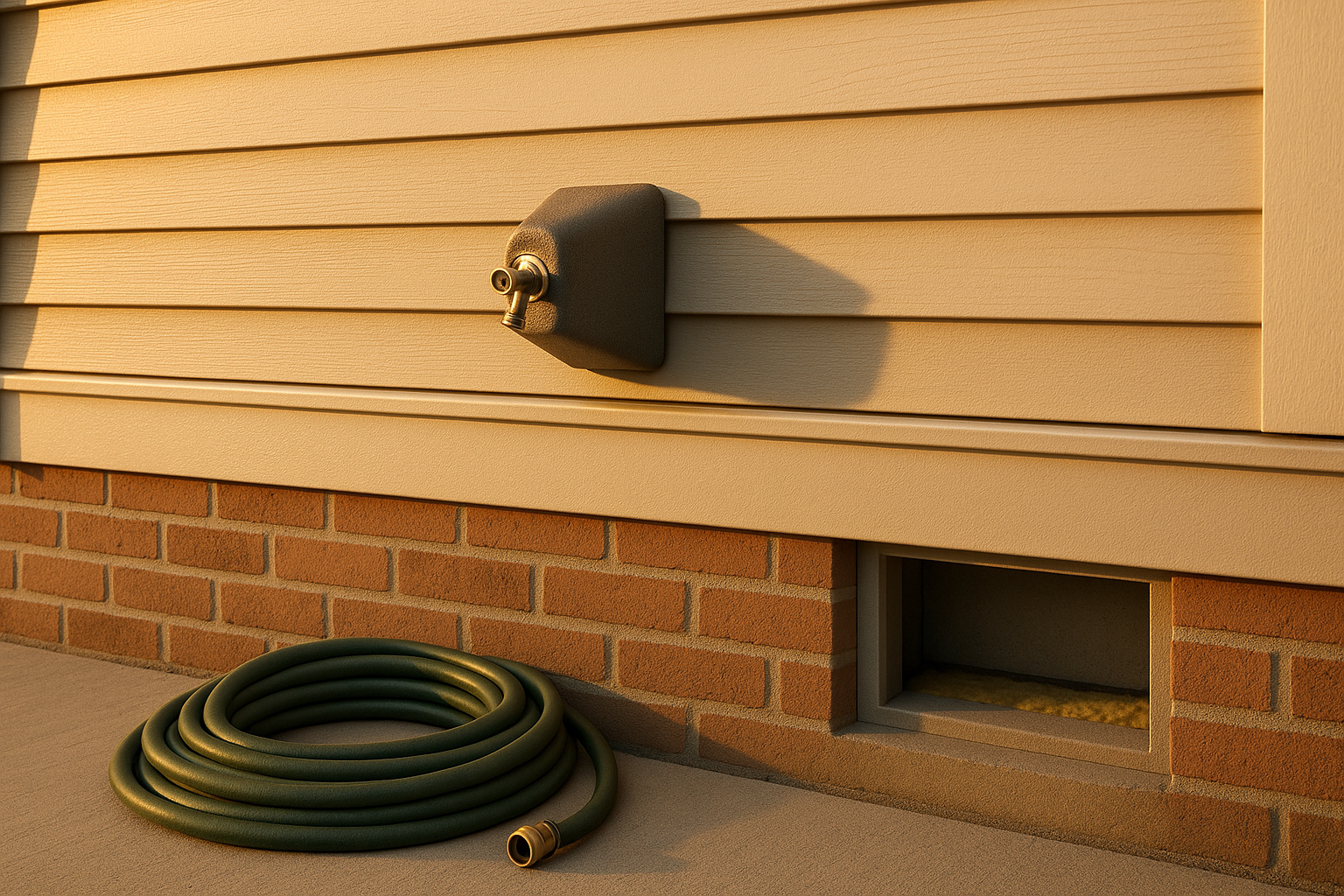
Last year a homeowner in Broad Ripple called us in a panic the first week of November. She'd left her garden hose attached to the spigot on the north side of her house. The water inside the pipe froze, expanded, and split the copper line inside her finished basement wall. She didn't know until spring when she turned the water back on and water poured out from behind the drywall. Fixing that mess cost her thousands. Don't let that be you. Outdoor faucet freeze protection isn't complicated, but it does take a little planning before the first hard freeze hits Indianapolis.
Why Indianapolis Homes Are Prone to Frozen Outdoor Faucets
Our winters aren't just cold; they swing from freeze to thaw and back again. That repeated expansion and contraction is what splits pipes. Add in wind exposure on north and east walls—common in neighborhoods like Fishers, Carmel, and Zionsville—and a standard hose bib has almost no defense. Older Indy neighborhoods like Irvington, Fountain Square, and Speedway often have uninsulated rim joists, so cold air leaks right into the space where the faucet line runs. If you've got a finished basement, you might not even see the leak until it's too late.
Quick Pre-Freeze Checklist (Do This Before Late October)
You don't need special tools for most of this. Here's the simple order to winterize an outdoor spigot:
- Disconnect every garden hose, splitter, or quick-connect fitting from the faucet. A attached hose traps water against the valve.
- Find the interior shutoff valve for that faucet. It's usually in the basement ceiling near the rim joist, or in a utility room if your home is on a slab. If you can't find it, check our guide on how to shut off water in an emergency for tips on locating valves.
- Close that interior valve all the way.
- Go back outside and open the exterior faucet to let any remaining water drain out.
- If your shutoff has a little bleeder cap (a small brass cap on the side of the valve), open that too and catch the few drips with a small container. Then close the bleeder and leave the outside faucet half open for winter.
- Slip an insulated faucet cover over the spigot. You can get them for a few bucks at any hardware store.
That's the basic hose bib freeze protection routine. It works for standard faucets. But if your faucet is a frost-free model, you still need to do steps 1, 2, and 3—more on that below.
Frost-Free vs. Standard Faucets: What's the Difference?
A standard hose bib has the water shutoff right at the handle outside. A frost-free sillcock moves that shutoff point about 12–18 inches inside the wall where it's warmer. The trick is that the pipe inside has to slant slightly downward toward the outside so water drains out by gravity when you turn it off. If it's installed with the wrong slope, or if you leave a hose attached, water stays in the cold part and can still freeze.
Many frost-free models have a built-in vacuum breaker (anti-siphon device) on top. That's important because it prevents contaminated water from siphoning back into your house. But that little device can also trap water if you don't relieve pressure. So even if you have a freeze-proof outdoor faucet, you should still shut off the interior valve and drain the line for winter. It's cheap insurance.
Interior Shutoff and Bleeder: The Unsung Hero
Not every home has a separate shutoff for each outdoor spigot. If yours doesn't, or if the valve is stuck or hidden behind a finished ceiling, that's a problem. You can't drain the line properly, and a faucet cover alone won't save you in a deep freeze. In that case, it's worth having a plumber or handyman install an accessible shutoff with a bleeder. We do this often in homes in Greenwood, Brownsburg, and Plainfield. The bleeder lets the line empty completely, which is the whole point of winterizing.
Insulation and Air Sealing: Stop Wind-Driven Cold
Even after you drain the line, exposed pipe in a cold crawlspace or unheated garage can still freeze if it's not insulated. Closed-cell foam pipe insulation is easy to slip over copper or PEX. Also look at the hole where the faucet goes through your siding or brick. If there's a gap, seal it with exterior-grade caulk. In older homes around Meridian-Kessler and Lawrence, the rim joist bays are often wide open. Stuffing insulation into those spaces and covering them with rigid foam board can make a huge difference—not just for your faucet but for your whole basement. Outdoor faucet freeze protection also means stopping cold air from reaching the pipe.
Heat Cable: When You Need a Little Extra
Sometimes you have a pipe run that's impossible to drain or insulate fully. Maybe it runs through an unheated garage wall or a crawlspace on the south side of Avon that still sees freezing temps during a cold snap. In those spots, heat tape can help. But only use UL-listed heat cable designed for pipes, and plug it into a GFCI outlet. We recommend models with a built-in thermostat so it only runs when it's actually cold. Don't use cheap unlisted tape. That's a fire risk.
Common Mistakes That Lead to Freeze Damage
- Leaving a garden hose attached. This is the number one cause of burst outdoor faucets.
- Relying on an insulated faucet cover alone without shutting off the water inside. A cover helps, but it's not enough in subzero weather if there's still water in the line.
- Installing a frost-free sillcock without the proper downward pitch. It looks fine but doesn't drain.
- Using unlisted heat tape or wrapping it over itself, which can overheat.
- Blocking the weep hole or not removing a quick-connect fitting that traps water.
Warning Signs of Freeze Damage
After a hard freeze, go outside and check your faucets. If you see water dripping from the spigot even when it's closed, that could mean a split inside. Inside the house, look for water stains on the ceiling near the sill plate, a musty smell in finished lower levels, or low water pressure when you turn on an indoor faucet. Sometimes the damage only shows up in spring when you repressurize the system. If you suspect a problem, don't wait—call a pro before you turn the water back on.
Winterization Help from a Local Pro
Doing the basic steps yourself is great. But if you can't find your shutoff, or the valve is stuck, or you want to upgrade to a frost-free sillcock with a proper interior shutoff and bleeder, that's where we come in. HandyPros services Indianapolis and the surrounding areas, including Carmel, Fishers, Westfield, Noblesville, and more. We'll do a planning-first site check, explain exactly what you need, and use quality materials. No mess, no surprises. We can also insulate and air seal the rim joist area, install heat cable where needed, or replace a leaky old spigot.
If you're ready to get your outdoor faucets ready for winter, request a quote online. We'll come out, take a look, and give you a clear scope of work. Better to spend an hour now than deal with a flooded basement come spring.
Ready for a free estimate?
Send us the list, and we'll quote a flat price before we schedule — no pressure, no obligation.